Showing posts with label Educational. Show all posts

Tuesday, April 30, 2013

Lesson Schematics- and Test

Before you get into this lesson, it’s important that you already have a basic understanding of common electronic components and circuits.

Schematics are symbols that help capture the essence of what a circuit is doing. They are used to show how electronic components are connected to each other, but may not necessarily reflect the physical position of a circuit. They are very similar to how we use symbols to communicate on maps
We see this on a map and know it’s a gas station without
having to have a picture of the actual gas station. 
Using schematics we are able to communicate to other people about the circuit. This makes schematics part of your electronics language and like all languages you will need to learn vocabulary.

Like all languages, it’s best for you to keep a reference of what you are learning. If you find that you do not understand a particular schematic it’s encouraged for you to look it up (like a dictionary). If you aren’t sure of how the component that the particular schematic represents, it’s a good rule of thumb to seek out the component and understand how it works yourself.
Many of these resources can be found on www.rapidtables.com

So, let’s get started

Since electronic schematics evolved from electrical wiring diagrams, we will start with the wire.
It’s important to note that wires in a schematic assume almost 0 resistance, which unless noted will be the same assumption that we will be operating on. 

Wires are generally shown by lines.
Electrical Wire or Conductor of Current

When wires are connected together, they are shown like this: 


Connected Electrical Wires

And when they are not connected they look like this: 

Not Connected Wires

Next- Power Sources-

One of the things that is helpful to identify is the power sources and grounds.


You will also run into places where a wire will simply have 5V or GND labeled, it’s most often found in microcontroller schematics where power is coming from a development kit (like the LaunchPad).

Once you've identified your power sources, it’s a good starting point to start to follow the flow of electricity.


Polarized vs. Non Polarized:


Some of the schematics are directional or polarized, where it matters what direction they are placed in the circuit (diodes, transistors, motors). Others, it doesn't matter which direction the component is placed (resistors, capacitors, inductors). Sometimes schematic writers will try and help you know which direction something needs to be placed by putting a + or a – , or a dot for GND to be found where it connects with the wire.


These are symbols that are not polarized:


These are symbols that have a + or a – and need to be used correctly.

Figuring out symbols before looking them up.

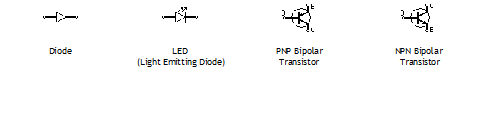
Take a look at the Diode symbol: 


Now look at the LED symbol:


If you notice, the only difference between the LED symbol and the diode symbol is the arrows pointing out.
This is because an LED is a Diode Light is Emitted (or sent out)

Now, look at this symbol: 


What direction the arrows are—this means that the diode accepts light.
This symbol is a photo diode.


Now take a look at the resistor: 
And look at a variable resistor:

The only difference between the resistor and variable resistor is an arrow diagonally.

Take a look at this symbol and see if you can figure out what it is:


*hint, it's a capacitor* 


Many times schematic symbols actually LOOK like the components they represent.

See how many of these you can identify without having to look them up. 


Friday, March 29, 2013

LaunchPad- Proto Plate from Ponoko

One of the things that has irritated me when I am working on my LaunchPad and using a breadboard is how both seem to move around a lot...
which is why I wanted to find something to "fix" both down for a cleaner look-feel. 


So, I had a few of these "protoplates" made-- I fell in love with the one from AdaFruit for the BeagleBone and really wanted one for the LaunchPad and had some made.

(I have to thank Bart, if he's on here, for really making my first Ponoko trial-run so smooth). 


2013-03-29 07.44.23


So here is where you can order the sheet: http://www.ponoko.com/design-your-own/products/launchpad-proto-plate-9765 
It's 14 total plates on the Plastic- Acrylic- Clear- 3mm- P3 sized sheet, which comes out to be about 3.50 for each plate- total about 46.50 (Bart had free shipping since he's a regular user at Ponoko). 


LaunchPadBaseLayout-[Converted]


I'm sure there is a more efficient way to arrange these to get more on the same sheet (there was a lot of extra plastic that wasn't used).
This was a trail run for me. 

It comes in a large sheet, where you only need to pull off your plate

2013-03-29 07.37.46


I left the backing on the plate--


Added the breadboard:


these breadboards from Mouser (I get them in packs of 10 so it comes out to be about 4.95 a piece)


The hardest part was to figure out how to connect the LaunchPad to the sheet.


Even though it's nice that the rubber feet were already included... it turned out to be inconvenient.
The BeagleBone and the Arduinos have screws that allow you to use standoffs. 
In this case after trying:
hot glue, epoxy, these scrapbooking "zots" (super strong adhesive tapes in dot shape) and double stick tape and found out that all of them don't adhere to the rubber well. 
What's worked is Crazy Glue. 


Put it on the LaunchPad, set it down and let it dry... 


then I peeled off the backing. 


I'll get to test these in a workshop soon, but so far I like them, but plan on changing a few things. 
It's hard to know which direction is up...
I have two sleds and one is right handed and the other is left handed... I guess if I just removed the logo all together I could have it be either right or left handed 


This is what I think my next one will look like, but I'm completely open for any suggestions!
I'd prefer those to be on the discussion board here: 43oh Forum


Hope that's helpful, I've included the files to make the edits in my dropbox (it's in illustrator and the forum doesn't like the format for some reason). https://www.dropbox.com/sh/6tho7jrplryvyhl/PJAJ22XqpQ

Monday, September 17, 2012

Academics vs Educators: Thoughts on Faculty Make-Up at Universities


"Universities are Institutions which the educators have lost interest in the students."

Several years ago, I penned those words for my University Admissions essay to a prestigious school in the US as a high school senior applying for her undergraduate degree. My admissions essay proceeded to blast University Systems for not focusing on their largest constituents, the students. I never got into that school. I had gotten a generic, "Thank you for applying, but unfortunately..." letter that didn't go into any sort of detail. But it was that view I held onto for the greater part of my education. 

With such a controversial admissions essay I was surprised that a few Universities still wanted me. (Granted, some of them had automatic admissions for top 10% of your graduating class, but there were a few that found my essay provocative and after all of the chips fel)l-- I managed to get myself into a decent school, with a few scholarships and a good prospect for full time employment afterwards. Several years later and now in a position where I work intimately with Universities... on the subject of Undergraduate Education-- I've refined my opinion... and found it interesting opinion shift. 

"Universities are Institutions which the educators have lost interest in the students."

Universities, or any post secondary education, voluntary education are also known as Higher Education. Most of these schools are voluntary attendance and are a place where students may continue their education. Wikipedia has a good download on the general statistics and facts about Universities. 

The United States has a total of 4,495 Title IV-eligible, degree-granting institutions: 2,774 4-year institutions and 1,721 2-year institutions,[2] an average of more than 115 per state. As of 2010, the US had 20.3 million students in higher education, roughly 5.7% of the total population.[3] About 14.6 million of these students were enrolled full-time.[4] -Wikipedia on US Higher Education

It is accepted across most Industrial Societies that Universities are an integral part of the fabric of society. These are places of learning, research, development and... teaching.

The word Institution has it's own set of connotations. 
 Rom Harre that states: 
"An Institution [is] defined as an interlocking double-structure of [people] with [jobs] and [administration] and of social practices involving both expressive and practical aims and outcomes." 
How do I interpret that?
There are two parts to an institution. 1. The goals/aims of the institutions creation
 and the 2. resources required to achieve those. 

Applying to Universities, a University is united in purpose and cause or establishment, but requires resources to exist. These resources are a combination of those who are simply a part of the Institution, are a contributor to such or are managing aspects (if not the entire) establishment.

The major point to me?-- Universities are complex multi-layered objects that require resources at all levels to function. (Keeping that in mind helps shape the remainder of what it takes to understand certain issues (such as Students' importance being downgraded).)


 Perhaps a long way to get to the point, but I find it helpful to step through each level as I discuss it. 
Universities are Institutions 
Institutions require Resources
Resources are People+Skill Sets+ Immediate (Tools and Equipment) Assets+ Future Investments
More Succinct: Tools + Equipment, Hiring and training of people, and Investments= Need Funding
Bottom Line: Universities = Need Funding


*Side Note* If one ever wanted to understand the motivations of a particular University for shaping their curriculum as it is... one only needs to see the sources of funding. 


"Universities are Institutions which the educators have lost interest in the students."
Since Universities the constituency is assumed to be students... a University will always have a student component to their charter. 
A way I often look at the quality of a University is by measuring the quality of students. 
Looking at the institution as if it were a process and the student was the output. 
As with most things you can judge it either by it's process or the result. Although we often say, "It's not the result of the game, but rather how you played it..." (process) by human nature we will always put more importance on the direct impact or (result).
In the United States, the calibre of a University is often times measured by either the types of students it attracts or... the types of students that it outputs. 
None the less, every University must have a paradigm where students are an integral role. 


"Universities are Institutions which the educators have lost interest in the students."
This is where my statement... is in need of being revised.

Looking at a University and assuming all of the people part of its ranks had Education first in mind ... is similiar to the frustrations that I feel when someone looks at the company I work for and assumes all divisions are exactly the same. In Universities, Educators, although perhaps integral part, are not the only division of labour.

 calling out the major groups (according to my view) within a University. 
Administratives, Academics and Educators. 


Academics and Educators are different


Both Academics and Educators are found in the same place, Universities. 
Both have a propensity and a drive to learn/discover. 
The key differentiator between an Academic and an Educator though is how they use the University. 
Academics are focused on the learning of a new idea/concept or in more common terms Research. Their view on the University is about using the University as a vehicle to other things (more research).

It's Educators that take that same focus on learning... and instead of applying it to external topics ... they apply that interest and energy into the classroom/students= Teaching.  Educator's view on the University is as a purpose/mission/responsibility. 

Both have their own merits and values and neither one nor the other is better than the other. A University is judged greatly on the type of students they can attract or the type of students they can turn out and both Academics (Research), Educators(Teaching) and all of the Administrative functions (viewing Universities as the main focus) the are all needed. 


For an Institution to be healthy, it's the balance of these segments that really makes a difference. 

I had the opportunity to sit in a University visit where the focus was clearly Research Centric. 
The VP that I was with opened the meeting with the following:

"I'd like to spend some time talking about your teaching before you go into your Research. I feel what you teach your undergraduate students is what a school really believes."
*Side Note* We ended up funding the department anyways, (Luckily the faculty in the room didn't bat and eye and enthusiastically agreed). 

Where the problem arises is when the University begins to tilt the balance to other segments at the detriment of other segments. Issues such as: Funding or Resources are usually primary drivers.

My VP asking the University to first speak about their Educational efforts was checking the program's balance. Too often a school will be spectacular at turning out researchers and projects ... but the students that are attending don't get any of the benefits. I personally chalk it up to an imbalance.

Examples:
Here are a few observations I've had from traveling and looking at different school's curriculums in regards to what type of students they tend to turn out... (of course there are different extremes, I only selected a few):

========= Examples of Imbalanced Curriculums=========


 Evolving Institutions- We find these types of schools when either the department is new, there is an interim head from a different school. distance ed type of curriculums or there is a LOT of turn over in the department. 

+ These are fairly regimented and process oriented curriculums. There is very clear paths. 
+ There oddly usually is a lot of flexibility in the curriculum and special programs such as study abroad, outreach and work-study. 
+ Many times these curriculums use material from other schools, so you can get the same material as a more prestigious school (depends on the teacher). 
- Faculty is often times not motivated to go against the processes and instead are only there to collect pay-cheques. 
- Students are left to fend for themselves. 
- Resources are usually consumed outside the department and students don't get to see the results. 

The types of undergraduates these tend to turn out... are usually very well rounded in all disciplines... but weak on the technical skills they obtained (e.g. Electrical Engineering).


 Research Institutions- Schools where the faculty is mostly composed of researchers.
+ Best and Brightest minds are attracted to the facilities and the prestige in working at these schools
+  University has access to direct funding for the research and publicity
+ Students have access to cutting edge research ideas
- Requires a great deal of resources to continually attract the best
- University usually becomes specialised in a particular area.
- Students are often not taught by the professor, but rather TA's or Graduate Students 

The type of undergraduates these tend to turn out are... future graduate students/ require re-training when they are hired by employers. These students usually are lacking strong fundamentals or are very specialized into one area of expertise.


 Teaching Institutions- Schools where the faculty is mostly composed of educators.
+ Strong focus on fundamentals 
+ Faculty is focused on the students
- tends not to attract big names or "wow" factor faculty.
-funding may be difficult to obtain 

These types of graduates are my favorite. However, I have run into issues where they are too theory based without enough hands-on-research like exposure. These tend to be technically sound graduates that may need to be refined.


========

As with most venn diagrams, the overlap is usually the most interesting. 
Below is my take on the type of faculty that exists within each of these segment. 
This is where a few pivotal faculty members can easily change the dynamic of a curriculum. e.g. A strong researcher that has interest in education can bring his research into the classroom to give students a hands-on experience. An Educator with an administrative bent may want to standardize the curriculum and offer more options. Most importantly, I have found that department heads that are well balanced... tend to manage programs that tend to mirror that balance. 


You can also take the same diagram and map out examples below:
Using the Stephen Hawkings: "Students are the transition between the layman to the expert" and my Bamboo Writing Tablet to scribble my notes...


I'm sure there are more things that I can put on these graphs. 
Looking back on that college admission essay, I should have revised my statement to 

"Some Universities are Institutions which the educators the Academics have over-whelmed the Educators and the University has lost interest in the students."


... and focused on the merits of Teaching Institutions over Research or Administrative. In the end it really just depends on how that University sees the value of each of these departments and knows what type of student they wish to turn out. Good, Bad... Indifferent... because Universities are voluntary, it ultimately comes down to the student's choice... which, in my case? I would have chosen a teaching institution :-)


Overview of Main Points:
  • Universities tend to be large and complex organizations and expectations should not be that they are only made up of Educators. 
  • In a University the need for resources drives a lot of decisions. 
  • Both Academics and Educators exist to pursue learning. However, Academics/Research pursue learning using the University as a means versus Educators pursue learning as their purpose. 
  • The Administrators in the University are important to offer extra curricular and services. 
  • The balance of these departments influences largely what type of students the program will output. 


Tuesday, July 17, 2012

The Dark Ages are Coming for Engineering Education...


Aside from that, this is a bit of rant... and this is what set me off:

Around Christmastime I was given one of these by my mother's boyfriend. Unfortunately somehow I had lost it during the move and with my mother and her boyfriend coming to visit soon-- I decided to go and buy one to replace the lost one. 

Meet my Apple "Magic" Trackpad.

It's nice.
I like it and enjoy using it.  After all, its a very well designed multi-touch capacitive touch bluetooth mousepad. It's exactly like the trackpad on my macbook, except I can sit on my couch and use it instead of having to have the machine on my lap. No problems here.

But, it's not the product that I object to...

It's the Marketing of the product.

Marketing a consumer electronics product as "magic" really does not do me any favors. Labeling electronics as "magic" gives the people the illusion that those who design/work with electronics are some class of "wizards and warlocks".

Just because you cannot see electrons moving with the naked eye, doesn't mean that it's magic.

Consider, several hundred years ago we couldn't see germs... and doctors in the middle ages were seen as a cross between a religious man and a wizard. There was no understanding on what made people sick, where disease came from-- and people lived in fear and superstition about life and death. The common man was vulnerable for those who wished to take advantage of these fears and superstitions. The practicing early health care professional struggled to overcome the emotion and misconception in order to advance their profession.
A Mid-Evil Alchemy/Health Chart

It wasn't until the breakthrough of understanding germs and micro-organisms did the medical profession begin to make significant advances. Furthermore, it wasn't until the layman understood these impacts did we see the benefits of these advances. No longer was being a doctor a charter handed down from God, but rather it was a learned skill to contribute to the common good. 

Look at modern day. Except the issue at hand isn't the germ, but rather how electronics work. In a day that more and more consumer applications are having higher levels of electronic content, it's odd how little the common person understands the mechanics how those devices work. As the dependency on these items increases so should the amount of people who understand them. But it's not the case. 

In America, it's harder and harder to recruit students to want to become electrical and computer engineers working with electronics. Engineering is difficult to begin with, but Electrical and Computer Engineers are seen as a subclass within these groups. 

I remember when I was in school seeing a shirt that said, "You can't spell "Geek" without EE". More recently I saw a similar one that said, "You can't get spell "Creep" without EE." 

The overall issue? It's difficult to get students to relate to and understand what a EE or CE major does. 
Mostly because there is a sort of misconception that what they do is on par to communing with the "dark arts" and only those with very special powers should/could/would want to do that. 
After all, "magic" can only be preformed by a select few.

As comical as it is to imagine looking at the electronics industry almost like a Harry Potter book... as an Engineering Education professional, I'm more alarmed by the subtle cultural impact these attitudes have.

First, it perpetuates the "us" versus "them" mentality. That knowledge of electronics would not normally cross camps and should be concentrated to an elite few (which is probably why Apple also refers to their store helpers as "geniuses"). 

Second as a result of elitism around electronics understanding there comes a risk that there are too few players in a market that...

Thirdly, is growing and people are starting to shape their lives around and become dependent upon.

 (If you don't believe me on this dependency, go and put a little ball of paper between the ethernet jack on your router/modem and the ethernet cable... and watch how vehemently the occupants needing the internet act when they can't figure out what's wrong. Props for anyone who has someone in their house that will unplug it and look to see what is causing the issue, but I doubt they would go through the trouble). 

Fourth, this same population that is trusting that the technology they are using is there to enhance their lives will be first to cry out and call foul when a perceived offense occurs... and somehow the lack of their ability to make an informed decision is blamed on the few (pretty much analogous to the American Financial Systems where people were taking out home loans they didn't understand trusting that the Bank would tell them if something was amiss).

Lastly, other countries don't appear to have this same passive attitude for understanding electronics. And although we may be innovators today-- as the supply of engineers dries out, we will have to turn to other countries to fill those demands. Instead of driving innovation by having the best and most creative minds at work, we will just be maintaining the status quo.

If anyone were to make a significant impact to helping reverse this?... it could be Apple.
Apple with their incredible reach, cult following and ability to inspire people to appreciate technology is  amiss their responsibility here.
Instead they choose to perpetuate the gap between electronics know-how and the layman. Charging a premium for the "ease of use" and benefiting from the fact that many people can't bother to learn how the product works.
After all, why would you when a "genius" will answer your question about your "magic" product?

Type in the word "Magic" on the Apple Store and these are the results...


On that note...
I have to go to work.
And I will need to resist the urge to re-name all of my daily interactions at the semi-conductor company I work for with World of Warcraft references.


PS.
IF you are interested here's a link to the Trackpad teardown.
I do appreciate how well designed the trackpad is. I just don't want to diminish the amount of brilliant engineering to something as superfluous as "magic".


Monday, July 16, 2012

A look at processing of communication


Since the primary function of language is to facilitate communication I wanted to look at the fundamentals of communication.
These are a collection of my notes that serve as background for me on other ideas:

A look at the processing of communication:


Communication is defined as:  is the exchange of thoughts, messages, or information, as by speech, visuals, signals, writing, or behavior. 

As with any system there are some inputs, a process and an output.
What makes human communication so complex is the ability for many concurrent channels to be opened at once. (It's this simultaneous processing and transmission of information that happens real-time that always fascinates me how wonderfully efficient the human design is. )

For simplicity sake we are going to focus on the person and assume all of this person's communication is received perfectly by the "outside" world bubble (we all know that isn't the case, but for the purposes of this, I want to narrow our focus).

Within the person, a look at the process segment:

First, I'd like to look at Resources.
Very similar to a computer, resources in this case is memory. 
I assert that the the process of increasing resources permanently is called = learning. 

Very simplistically I am going to assert that Resources for communication depends on : it's how efficiently the person can access their memory and what contents are present. 
(This is a very complex process and there are countless of research papers on the mechanics, but this will not be covered here). 


Inside of the resources is a memory process. 
Taking some input externally (or internally) the thought moves through short term memory into long term memory.  It's the growing of long term memory that = increasing resources= the learning process. 
This is very simplistic way of looking at how memory is processed, but the relationship between long term and short term memory needs to be kept in mind when discussing learning. 
Not depicted on that chart is how the brain removes information or forgets. 
If any part of this memory recall, processing, learning and filtering is broken -- the person will be considered to have a disability. 

There is a great deal of research on the causes of different disabilities and what part of the brain's information shuttling is off- e.g. bypassing short term memory and into long term is found as a symptom of autism. A weak link between short term and long term memory (the consolidation and categorization process) is what causes ADD. 

Next is a look at the input.
Inputs come from either internally actioned or externally. 
This is where our five senses come in. Our senses are the external input receptors we need to take data from the outside world. 
Once that data is received then the memory process can process it. 
The remarkable thing about the inputs is that unlike resource/memory problems, input problems can either be compensated through other senses or even replaced. 
It's very seldom that we only take in information through one sensor and often times it's the combination of all of the senses that delivers the most complete data transmission. The input can happen consciously or subconsciously. In the case of reading= conscious. In the case of sizing up a new person, most of the judgement occurs subconsciously with the result a "feeling" about that person. 
A little bit different is the internal inputs. 
I put emotions separately from memory. However these are inputs that happen either as feedback or pre-set conditions that go into the communications process. e.g. has a stomach ache and has a feeling of unease.


I wanted to cover the outputs before touching on the process.
The output are the results that are expected or happening during the communication. 
I view the outputs as the actions that happen as a result of receiving information. 
Either an action will be generated that can be viewed by the outside world or there actions that are generated internally that are not part of the outside world and may instead be an iteration of the process.

It's in the output that we see the differences between stylistic approaches.
Example: The difference amount of external versus internal communication is what makes the difference between introverts and extroverts. 

Now a look at the process. 


The chart is just an example of the decision that is being made for the particular input. 
The branched logic is something that our brains can process concurrently with multiple threads. 
Each step of the logic requires the information to be processed, matched against recalled information, compared, categorized then decision to either move to the next step or disregard. 

It's the combination of how many of these processes you have access to versus the ones you have to create from scratch that determines how quickly you communicate. 
It's the success of these processes that determines if you are likely to use the same method again.
Success= reinforcement = more likely to commit that particular process to memory. 

Once in memory, then the next factor is how quickly and accurately you can recall the information. 
(back to the resources section above). 

Many of these processes happen in our subconscious and only if we wish to defy the result we would need to modify the process.
The closer to the subconscious a process is, the faster the process happens = the less opportunity you have to modify the result. 

Since communication is the mechanism which information is received and transmitted-- then communication plays a large role in the learning process of an individual. 


The next step is to evaluate the communication mechanisms, in particular the use of language. 
Since communication is the process which information is acquired then the mechanism which communication occurs would be through language.


Monday, June 4, 2012

Digital Measuring Tape/Odometre

#ideasforProjects

Inspiration: I got this idea watching the intern assigned to me, slide the launchpad back and forth on the desk while he was talking to me.

I really like the form-factor of the launchpad, but outside of it being... well, a Development kit, it doesn't relate well to people who don't already know what you can do with a Microcontroller.

e.g. One of the things that makes the Evalbot such a good platform is how it relates to the consumer right away. I've been looking to find something like that for the Launchpad.

So, watching this launchpad slide back and forth on the desk while my intern discussed his week's workload progress-- the idea of cemented itself.

What if we could make one of our launchpads into a fun measuring device— like a tape measure?

Overall Concept:
Distance is fairly simple to measure.
If moving in a straight line—You can also measure distance by a point of origin, knowing time and a direction.
You will also need to know the unit of measurement (inches, feet, miles etc). Maybe something like an odometer of sorts.

High Level things I need:
I’d need a processor. -Ideally this would be on a platform that could be battery powered.
I’d need a way to input point of origin (maybe a button click).
I’d need a way to count time (I am pretty sure we can use the clock cycles on the processor).
I’d need a way to know which direction I’m headed.
or I’d need to find a way to let the processor know that I’ve reached my end point (maybe another button press?)

Problem Statement: Biggest issue is that without some sort of unit of meaurement— the time is variable between users (I could click move the thing faster and end click than maybe someone else).
This person here: http://www.instructables.com/id/Digital-Measuring-Tape/ used a circle wheel.

Brainstorming--


  • Maybe I could use an accelerometre?  -- I need to look into that, are they sensitive enough to be able to pick up movement. When would measuring begin occurring and how would it differentiate between movements?
  • Does this exist already? I know there are hacks for Odometres today: http://hackaday.com/2011/01/19/make-your-own-odometer-from-scraps/ How can that example help?
  • Another idea for determining the end point--- I could use RF access points and use the broadcast strength of the nodes… Issue there is that I’d need 2 points versus just one. *granted lately I have been really fascinated with using the broadcast strength of wireless nodes as indicator as a useful measurement outside of QoS (that could be a blog post on it’s own).
Possible Solutions:
-I'd like to use the MSP430 Launchpad. It's cheap, it's got push buttons and can run off a battery pack... But the issue of determining the distance travelled or time/position seems a little complicated. This would require a hardware addition/modification-- which I'm frankly, terrible at.


-Another one is to use the Eval-Bot. It's got battery power, can run on its own.  It's wheels travel on a set timing and could count the rotations x circumference x time... and get a distance. There are bump sensors that instead of using them to detect what it runs into-- I could use the button press as a start and have the bot move forward and then the bump sensor to designate a stop. From the start to the stop would transmit the data. **appealing, because it could actually store the # of wheel turns + when it hits the bump sensor into memory-- and even to the SD Card. We could have it log it's trajectory when it started, when it hit it's bump sensor, what angle it turned and the wheel rotations then-- eventually with the bot + the travel paths you'd be able to measure the size of a room. Useful? Not sure.
Issue is that the Evalbot is normally at least 50+ dollars (on a good deal) and therefore not as attractive.

End Market:
This would be an ideal introduction to the MSP430 Launchpad to someone who just wanted proof on what a micro could do. This relates well to the mechanical/home depot DIY audience versus the Capacitive Touch Demo that is cool-- but for most non-EE/ECE degrees wouldn't imagine where they could use it. This would be a much more relate-able demo + actually be useful.

For the Evalbot? This would really be just a good Computer Science type of exercise in writing code. The peripherals are all there, just the use cases and programming needs to occur. A good lab exercise. Even better if you can transmit the information via wireless to a computer-- or find ways to optimise its path in the least amount of turns. (e.g. If you run into a 90 Degree Corner (both bump sensors activated simultaneously), the bot should assume it found a Room's Corner -- turn 180 degrees and drive straight to try and measure the room's hypotenuse).

Status:
Draft

Thoughts on Education- Introduction to ECE using TI EVALBOT

The below blog is a work in progress--

Setting expectations with TI's EVALBOT.

Robotics are a fantastic way to get students engaged with Electronics. I'm a particularly avid supporter of the tops down approach for students--but find myself a little conflicted in regards to Introduction to Electrical and Computer Engineering courses.

The conflict occurs when I see hardware at the Intro to Engineering courses-- that are either some version of a toy, or on a platform that a student will never encounter in Industry. It is my opinion that this is acceptable when education is compulsory (in high school or in clubs where vying for the student's attention is critical),  but at the University level and Vocational College level-- exposure should be as relevant as possible. After all, most students the purpose of going to college is to be employed when they graduate. Shouldn't the expectation be set in the very beginning to learn on platforms students would run into as engineers in the workforce?

*Side Note: The inspirational teaching model for me is the Auto Industry and how many kids become Mechanical Engineers. E.g. When a teenager gets interested in cars... he usually begins to learn about the object of his interest the car and doesn't get a golf cart first to learn on.

Not to demean platforms designed to capture interest of non-electronics audiences.

 Broad appeal platforms do exactly that-- grab people's attention! Once the attention is obtained-- then it's up to the skill of the instructor to make the associated concepts apparent to the student. Otherwise, the experience is no more effective than a structured play session... and we don't need to pay for structured education for that.

My primary concern in using toys or simplified versions of tools is this: there is the danger that the follow on courses will be so different from the safe, well structured environment that the student was exposed to-- that anything that is fairly industry standard will shock and feel like foreign world. This in turn will demotivate a student!

One of my favourite University visits was when a student who had been programming exclusively in the Arduino IDE opened up a competitor's IDE (also Eclipsed based framework) and let out, "Well, we aren't in Kansas any more." He proceeded to tell me all of the deficiencies in this framework using Arduino's simple editor as his reference point. Sadly, if he looked at TI's IDE, he would have had the same complaint or even IAR Systems (the top choice for most embedded designers).

It's expectation setting.

Teach a student that programming can happen in three clicks... and every environment after that one will feel "wrong".


However, teach a student incremental concepts that he or she can personalize/relate to-- and not only are you teaching students-- but you are also preparing them.

I am convinced that students who's first experience with hardware/software that doesn't go 100% perfect-- learn how to ask the questions to WHY certain conditions exist. Those who end up being some of the best engineers in inudstry ask, "How can we prevent this in the future?"

Taking away that real world experience? Insulates the student from common WHY? questions they would have begun to ask. Worst yet, it pushes it into after they graduate when their performance is in evaluation.

Some of my best teachers did not shield me from difficult concepts early on. In fact, many times they did not hide the difficulty of the concept, but instead used it as an opportunity to gauge my comprehension abilities. They were in essence outlining the requirements and letting me assess my own abilities against that measurement.


Let me give you an example of a course that is currently in testing phase.

At the Introduction to Electrical and Computer Engineering level- freshmen are required to take this course in conjunction with the Introduction to Engineering.


The first course consists of a video-- of this re-brained Roomba running a course.

The professor takes time to introduce the concepts that are taught in creating one of these.
Microcontroller, software, controls, programming , etc.
He ends the lecture on explaining that students by the end of their time will be able to create systems that are much more complex and fully featured.
He doesn't spend a great deal of time "dumbing" down the concepts. He uses the real terminologies and shows the actual use of the concepts. 

The second time, they are introduced to EVAL-BOT.

Perhaps the students don't understand what a Quadature Encoder is and how it functions, but the term is introduced.
I asked what was the basis of introducing these terms even though most of the students won't know what it is. He replied, "The interested students can look it up, the students that aren't will run into it later and have heard it before."
This section is about unboxing the Eval-bot and using it as is-- the finished product.


The next session is now introducing the concept of changing the fixed function that the bot shipped with.

e.g. "That's nice that the bot does this little roomba routine, but say that I wanted to tell it where to go-- how would I do that?"

Discussing what would need to happen to change the robot's function-- adding interfaces, changing the program-- then allowing the students to try it out.

*Stellaris has a neat FlashProgrammer that allows students to re-flash any of their development kits to a different demo (that has already been loaded into the FlashProgrammer) without ever having to open an IDE.  This is useful if you're not ready to introduce C Programming yet. *Refer to this blog post on how to do this Evalbot Chronos Change.

The next meeting discusses the differences between changing a function-- to being able to alter a fixed function.

This is where the concept of "configuration" is introduced. This is where students open up the IDE and get an explanation of what an IDE is, what parts make up code. They then open the code that changed the Eval-bot's function in the previous lab and see the different parts. It's here we have them configure the bot to a certain specification.
 (e.g. Change the OLED display from Micrium OS EvalBot to - I <3 ECE-)

*StellarisWare helps with this step, that the individual graphics are just function calls and to activate the display is a function call.

http://www.ti.com/tool/sw-ek-evalbot

Then, the next lab consists of customizing how the robot behaves.

The student will insert a new set of code.
Explaining what has to happen on the lowest level for the code to interact with the bot.
Guiding the student through introducing new elements.
Eg. Adding the #pause# function for the Chronos Watch- Evalbot demo-- where hitting a button on the watch lets the bot go into a waiting state. or Making the Evalbot sing the first twelve tones of the imperial march.
Walking them through this example.

Then ... have them switch examples and try it out on their own + ask questions.


Often times educators forget. These are not just high school students sitting in their intro courses. Often times these are the top 10-20% of their graduating classes with SAT scores that would put any of us to shame.
These students are highly capable and should not be underestimated. It is mastering the correct balance of introducing concepts in the right order, plus being able to explain it in a manner that makes sense to the student-- that is the responsibility of the educator.

The payback is immense-- I've seen time and time again. Just like with pre-tests, it shows students what concepts they need to learn... so they are able to discern a level of importance themselves of what they are being exposed to-- this in turn makes the experience personal.

Give the student a target.
Let the student measure themselves against that target for progress.
Don't treat the students as if they are unable to understand.
Don't overreach comprehension-- focus on the facts rather than the potential. This is a Analogue to Digital Converter. An Analogue to Digital Converter is useful in taking real world signals and making the microcontroller act upon those. Next, go into more detail at the Analogue to Digital Converter section.
Expose the Student, Demonstrate for the Student, Guide the Student then give the student space to practise on their own.
 Have high expectations-- and students will most likely strive to achieve those.

I contend that students at the Freshman ECE Engineering level are fully capable of being introduced to serious microcontrollers early on--all they need is an educator that sets the tone for them.