Thursday, September 20, 2012

Thoughts on Microcontroller Platforms Types


I work for a semiconductor company and work with making/distribution of hardware development platforms.
As a semiconductor company, we sell silicon. However, silicon on it's own doesn't do very much-- so we have to develop methods to show-case the functionalities of the silicon. One of these methods is through  a tool platform/ tool chain.

These are some of my thoughts on the development of a perfect tool chain to evaluate microcontroller silicon chips.

---------

Types of Platforms:
I want to begin this with looking at the different types of platforms that are available today.
Because my experience is with TI micro controllers, the majority of what I am speaking to has to do with the observations around these platforms.
You can take a look at what platforms I am speaking to by going to the TI estore and looking at the micro controller offerings.

I propose that these tools fall into four main categories:


These are categories that I have assigned based off of my experience with the different types of functionality and their relative position in the design cycle. Mostly focused on the end customer's behaviour.


What do I mean about end customer's behavior?
I am going to use the perfect customer as my example case.


Taking each of these segments into account... we get
Defining
Planning
Execution
Delivering


in terms of micro controller evaluation...
It's 
Demoing what is possible to define requirements
Evaluating capabilities and required resources for planning purposes.
Executing on the development.
Delivering a product for production and distribution.


Demo Platforms- 
Purpose: Platforms that are made to catch someone's attention. 
Uses: Trade Shows, Sending these to media... show casing a particular functionality. 
Primary Characteristic: "Cool Factor". This needs to be the most "product centric of all of the kits. These kits could almost be a complete product on it's own. 
Best Practices: A STRONG and easy out of box experience. It needs to be quickly relatable to the lay-man or the new engineer. The better the out of box, the better the demo. 
Size also-- make this so it's portable and easily shown (tactile) versus being complicated and needing a lot of engineering to get it to work. It's about making it as relatable as possible. 

Opinion:  I almost would put these kits as whetting appetites. If it's designed correctly it gives the user the incentive to go and "pop the hood". The best ones allow a degree of customization without forcing the user to have to enter a full-blown development process.  


Here are a few of my favourite examples:

Absolute Favourite: MikroElektronika's MikroMedia using the Stellaris M3 board!

     
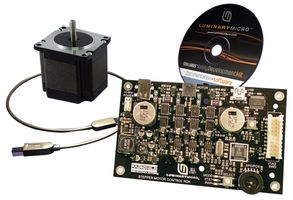
TI's EZ430-CHRONOS Watch and the Stellaris MDL-STEPPER that runs a Stepper Motor right away. 


Evaluation Platforms- 
Purpose: Platforms created to be able to enable a user to evaluate the chip set. 
Uses: Introduction to development environments, first entry point, get familiar with a product set. 
Primary Characteristic: This should be the "user experience" or the barrier to entry. 
Best Practices: To have the lowest business barrier of entry (cost), size (convenient) and to allow the user to expand the platform's abilities and grow with the user's skill.

Opinion: This is the most important kit of all in my opinion. This kit is an introduction to the product line. The best kits are about-- enablement. The entire design of the kit should be about enabling the user to 1.) learn the product and 2.) get going on the product. Because these kits should be designed to follow the user development-- it should be well designed to create incentives for the user to upgrade or add functions. 

Borrowed Image of the MSP430 Launchpad.


The best kit that has achieved this I've worked with is the MSP430 Launchpad. 
First, TI has taken away all of the business cases to why you wouldn't evaluate the MSP430. 
The platform is cheap, it's less than 5.00! Who wouldn't try something out for that. 
All of the hardware required is included (on-board emulation and debug). 
There is a development environment that is free and fully featured that comes with the kit. 
There is also a development environment that is good for a beginner. 
As you grow with the platform, you can change the centre chip out for larger function chips, or it can have functionality added with BoosterPacks. It's entirely where the user wants to take the platform. 
(Where this kit could use a lot of improvement is really on the transition of it's users from the layman to expert. Today there is a severe learning gap between new users and experienced users, but this is getting improved!). 

Here are some other Evaluation Kits that I like:
Predecesor to the LaunchPad. The EZ430 USB Tool.
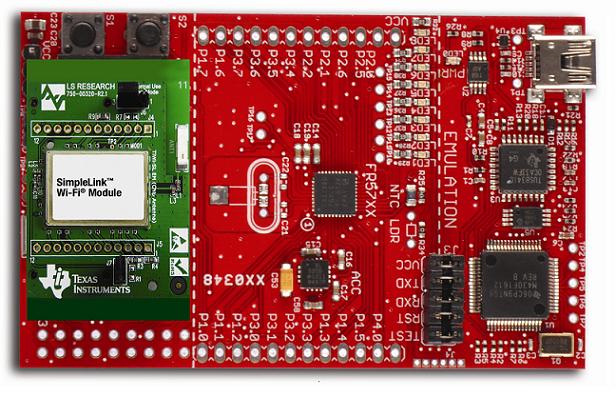
CC3000 evaluation on the MSP-EXPFR57xx board (FRAM Development Board)


The two major themes of these kits is User experience and enablement.


Development Platforms- 
Purpose: Platforms that are about delivering the full capabilities of a particular chip set. 
Uses: Chip Development 
Primary Characteristic: Full access to all of a chip's abilities and possible re-use for other chips. 
Best Practices: Re-use and giving complete access to a chip (e.g. pinning out all of the pins)

Opinion: This should be a kit that can be seen as an investment, but an investment that should only be made once. 
This is a kit that should be used by an experience user and focused on the development of a microcontroller project. These kits should be very prototype-able. 

The MSP430-U boards, a ZIF socket that can take any of the same packaged MSP430 Chips and all of the pins pinned out to the edges of the board.

The MikroElektronika Easy MX ProV7 for Stellaris


Production Platforms- 
Purpose: Platforms to help with production once development is done.
Uses: To mass-program chips, anything to aid with production. 
Primary Characteristic: usefulness! 
Opinion: Unfortunately I don't work enough with this segment of the business to have a strong opinion yet.  However, I speculate the primary use of this would be to enable production to be the easiest possible. 
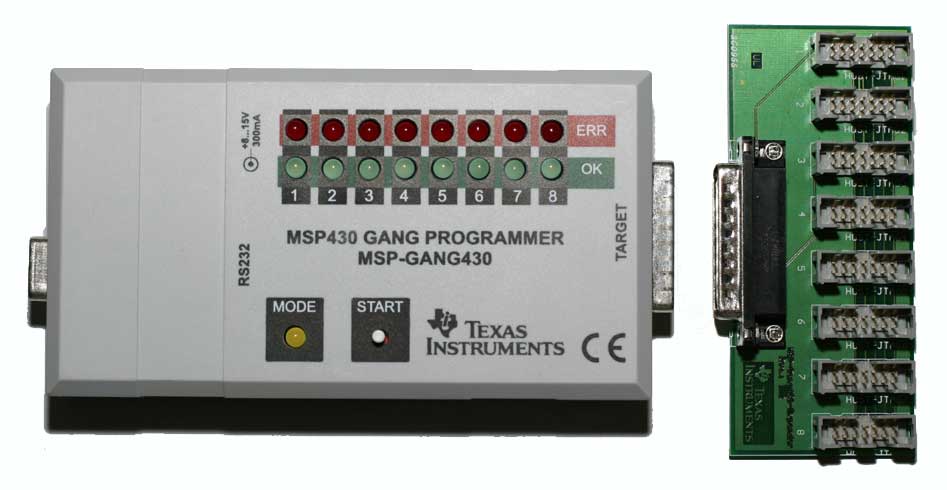
MSP-GANG430 Programmer for programming multiple MSP430 Devices at once.


Thoughts on the perfect Platform- 
After looking at all of the platforms, a lot of platforms overlap each of the categories. 
This should be encouraged and expected, but just like any all-in-one kitchen tool... there are always sacrifices that have to be made. e.g. if you wanted to use the CHRONOS Watch as a development platform... you can't get to all of the pin-out of the CC430 chip on board. That would prove to be irritating if you were trying to make a product that didn't do just a form factor of the watch. 

I would love to be able to take the first three platforms and create a type of ecosystem. 

What I would love to see:

Using a LaunchPad + A BoosterPack we would create the perfect Demo Platform
Demo Platforms get people's attention:

LaunchPad + BoosterPack

Once you have someone's attention then they can go to evaluate the platform:
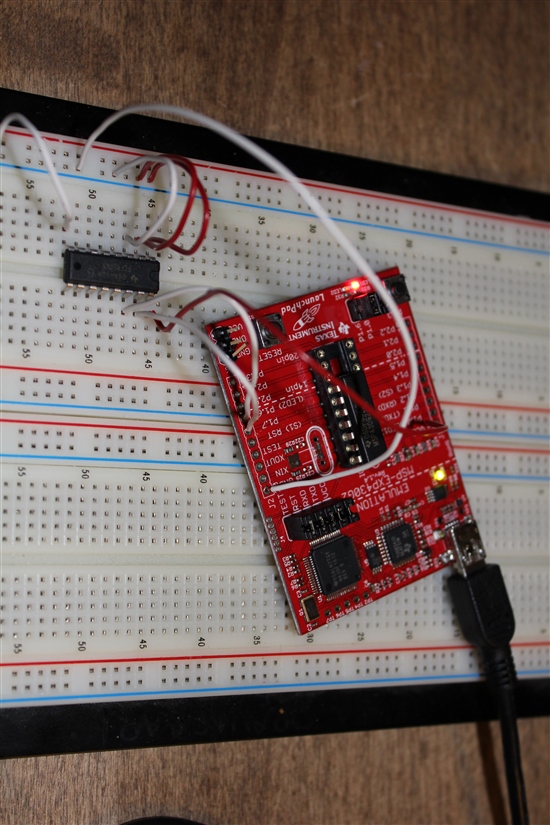
Evaluation with the MSP430-Launchpad

Advantages of making this the same platform as your demo platform is having an example to work off of. This keeps the application in mind. 

When you run out of capability, I would love to see the LaunchPad be able to plug into a board like the MikroE MX Pro v7


This allows the user to expand capabilities from a place of familiarity. 

When the capabilities of the LaunchPad Evaluation run out, then they can replace the socket with one of the Chip Socket Boards!

Taken from the MikroE User guide showing the card replacement.

The general idea is to allow the user to pace themselves through the development cycle on thier terms. (Just think about all of the times that I hit "IGNORE" when I get requests to upgrade software).
By allowing the user to decide when to move to a different platform you don't have to market as hard, the user is already bought into the value proposition (why would they move if they didn't need to) and they have a knowledge base that can be expanded upon (versus having them re-learn and figure out new connections).

So, that's what I would love to see...
An exciting, expandable, fully featured, evolving ecosystem centered around the user's comfort level. 


Amazon Prime- The Single's Costco

The other day, I was sitting in suburbia with my girlfriend and we had a conversation about Costco.

N:  I love Costco, we get everything there. You can get a gigantic thing of hummus and even DVD's for really affordable.
Me: That's awesome, but you live in a house. I live in 700 square feet and have no idea where I would put a year's worth of Toilet Paper...
N: True, but if you ever want to get food, steak, chips, drinks... you should give us a call!

Yeah, Costco is awesome.

I think I got a box of 96 Batteries there once, but the membership dues + the amount of things that I could get there... really doesn't make sense for my life style. After all, space + how much I actually consume + what services they offer... I can't justify paying the $50.00 membership fee.

What I really get behind is Amazon Prime.

I got hooked into Amazon Prime a few years ago when they upgraded everyone up to Prime to try it out.

Initially I scoffed at the idea of paying 80.00 some dollars to just get upgraded shipping. At the time Amazon actually delivered their Ground Shipping faster than the 3-7 business days they advertised... so, I didn't really value 2 day shipping. Not sure if was deliberate, but after my free period wore off... it seemed that the 3-7 days actually was taking the 7 days.... and it left me missing the 2 day shipping.

A year later, I decided to try out the Prime Membership again. For three weeks I had the upgraded shipping, but they then added a function that I was actually interested in. I could borrow Kindle books (The Kindle is still my favourite piece of technology to date). However, I decided to cancel the membership having done about 40 some dollars in shipping and didn't pay anything. *Props to Amazon's customer service.

Last year this time I decided to take the plunge.
Already, I was an avid Amazon buyer. About once a month I would make some sort of purchase. With my iPhone and the Amazon Scan It and Snap it app + my Kindle reading habit + the Audible.com affiliation... Amazon was becoming one of my most frequently visited websites. Before pinterest, I was using the Amazon "ADD TO WISHLIST" button to collect the things that I wanted to find somewhere else. In addition, my Roku player (which has since replaced my Apple TV) had Amazon as one of it's player options... and I had access to many of the TV Shows and Videos...

Admittedly, it wasn't the services that initially pulled me into the membership but ironically the free shipping. In my full time job working with Universities I found myself having to send book samples to professors on a regular basis. Having booked shipped to me, then having to pack it into a Fed-Ex box and ship it to the professor just seemed to be a very inefficient and needlessly resource expensive. Even though I wasn't allowed to put the membership as a work expense, I decided to buy it myself. A lot like when people bring a custom chair or cushion to their work cubicle to make doing their job much more enjoyable... not having to deal with shipping textbooks became appealing.

Shipping over 15-20 books a month + buying miscellaneous things like Soldering Flux, irons, used books, laptop cables, iPhone cases... it was starting to add up.

Then, I decided to try something new.
I travel a lot. Last time I calculated it, I am on the road about 70% of the time. Example: I had moved back to Dallas August 2011. By January 2012, I had been in Dallas a gross total of 34 Days (including weekends). When I am home, I spend my time having to re-pack, do laundry and get ready for my next trip... which leaves very little time for shopping. Needing Conditioner, a new razor, a facebrush replacement, some ziplock bags and ink cartridges for my fountain pen... I decided to buy all of it on Amazon.

Two days later and three boxes, they were all waiting for me nicely piled on my desk when I returned from a day trip to Houston.


Then, I got truffle oil, gesso, a tomato knife, paper towels and shower-gel.

Then Clay picks (had to make a model for someone), photography printing paper, ink for my printer and a USB Battery pack.

It was becoming more appealing to quickly cart something on my phone or computer... and have it sent knowing it would arrive in a few days...

Add in the lending for Kindle
The Free Audible Downloads for Prime Members
The access to Amazon TV
Letting me add three people to my account to use my Prime Membership.
Using a WishList like a shopping list
Being able to manage an address book of Professors.
The upgraded shipping.
and I'm officially hooked.

I don't need the bulk toilet paper, or steak by the cow's entire left side... what I need is something that is convenient and is able to cover my many whims and needs at the time I have them. Add in the added benefit of not having to go to the store and deal with all of the overhead of people... I can spend that time doing other things I enjoy.

Face Lotion
The Ad from Target that gets shipped to everyone.


I'm sure it's a matter of time for Amazon to partner with a grocery chain to do online grocery shopping (I used to do that in Minneapolis at Lunds and Byerlys when the weather was exceptionally daunting.) Amazon Prime can compete head to head with the Costco's and Sam's Clubs.


Monday, September 17, 2012

Academics vs Educators: Thoughts on Faculty Make-Up at Universities


"Universities are Institutions which the educators have lost interest in the students."

Several years ago, I penned those words for my University Admissions essay to a prestigious school in the US as a high school senior applying for her undergraduate degree. My admissions essay proceeded to blast University Systems for not focusing on their largest constituents, the students. I never got into that school. I had gotten a generic, "Thank you for applying, but unfortunately..." letter that didn't go into any sort of detail. But it was that view I held onto for the greater part of my education. 

With such a controversial admissions essay I was surprised that a few Universities still wanted me. (Granted, some of them had automatic admissions for top 10% of your graduating class, but there were a few that found my essay provocative and after all of the chips fel)l-- I managed to get myself into a decent school, with a few scholarships and a good prospect for full time employment afterwards. Several years later and now in a position where I work intimately with Universities... on the subject of Undergraduate Education-- I've refined my opinion... and found it interesting opinion shift. 

"Universities are Institutions which the educators have lost interest in the students."

Universities, or any post secondary education, voluntary education are also known as Higher Education. Most of these schools are voluntary attendance and are a place where students may continue their education. Wikipedia has a good download on the general statistics and facts about Universities. 

The United States has a total of 4,495 Title IV-eligible, degree-granting institutions: 2,774 4-year institutions and 1,721 2-year institutions,[2] an average of more than 115 per state. As of 2010, the US had 20.3 million students in higher education, roughly 5.7% of the total population.[3] About 14.6 million of these students were enrolled full-time.[4] -Wikipedia on US Higher Education

It is accepted across most Industrial Societies that Universities are an integral part of the fabric of society. These are places of learning, research, development and... teaching.

The word Institution has it's own set of connotations. 
 Rom Harre that states: 
"An Institution [is] defined as an interlocking double-structure of [people] with [jobs] and [administration] and of social practices involving both expressive and practical aims and outcomes." 
How do I interpret that?
There are two parts to an institution. 1. The goals/aims of the institutions creation
 and the 2. resources required to achieve those. 

Applying to Universities, a University is united in purpose and cause or establishment, but requires resources to exist. These resources are a combination of those who are simply a part of the Institution, are a contributor to such or are managing aspects (if not the entire) establishment.

The major point to me?-- Universities are complex multi-layered objects that require resources at all levels to function. (Keeping that in mind helps shape the remainder of what it takes to understand certain issues (such as Students' importance being downgraded).)


 Perhaps a long way to get to the point, but I find it helpful to step through each level as I discuss it. 
Universities are Institutions 
Institutions require Resources
Resources are People+Skill Sets+ Immediate (Tools and Equipment) Assets+ Future Investments
More Succinct: Tools + Equipment, Hiring and training of people, and Investments= Need Funding
Bottom Line: Universities = Need Funding


*Side Note* If one ever wanted to understand the motivations of a particular University for shaping their curriculum as it is... one only needs to see the sources of funding. 


"Universities are Institutions which the educators have lost interest in the students."
Since Universities the constituency is assumed to be students... a University will always have a student component to their charter. 
A way I often look at the quality of a University is by measuring the quality of students. 
Looking at the institution as if it were a process and the student was the output. 
As with most things you can judge it either by it's process or the result. Although we often say, "It's not the result of the game, but rather how you played it..." (process) by human nature we will always put more importance on the direct impact or (result).
In the United States, the calibre of a University is often times measured by either the types of students it attracts or... the types of students that it outputs. 
None the less, every University must have a paradigm where students are an integral role. 


"Universities are Institutions which the educators have lost interest in the students."
This is where my statement... is in need of being revised.

Looking at a University and assuming all of the people part of its ranks had Education first in mind ... is similiar to the frustrations that I feel when someone looks at the company I work for and assumes all divisions are exactly the same. In Universities, Educators, although perhaps integral part, are not the only division of labour.

 calling out the major groups (according to my view) within a University. 
Administratives, Academics and Educators. 


Academics and Educators are different


Both Academics and Educators are found in the same place, Universities. 
Both have a propensity and a drive to learn/discover. 
The key differentiator between an Academic and an Educator though is how they use the University. 
Academics are focused on the learning of a new idea/concept or in more common terms Research. Their view on the University is about using the University as a vehicle to other things (more research).

It's Educators that take that same focus on learning... and instead of applying it to external topics ... they apply that interest and energy into the classroom/students= Teaching.  Educator's view on the University is as a purpose/mission/responsibility. 

Both have their own merits and values and neither one nor the other is better than the other. A University is judged greatly on the type of students they can attract or the type of students they can turn out and both Academics (Research), Educators(Teaching) and all of the Administrative functions (viewing Universities as the main focus) the are all needed. 


For an Institution to be healthy, it's the balance of these segments that really makes a difference. 

I had the opportunity to sit in a University visit where the focus was clearly Research Centric. 
The VP that I was with opened the meeting with the following:

"I'd like to spend some time talking about your teaching before you go into your Research. I feel what you teach your undergraduate students is what a school really believes."
*Side Note* We ended up funding the department anyways, (Luckily the faculty in the room didn't bat and eye and enthusiastically agreed). 

Where the problem arises is when the University begins to tilt the balance to other segments at the detriment of other segments. Issues such as: Funding or Resources are usually primary drivers.

My VP asking the University to first speak about their Educational efforts was checking the program's balance. Too often a school will be spectacular at turning out researchers and projects ... but the students that are attending don't get any of the benefits. I personally chalk it up to an imbalance.

Examples:
Here are a few observations I've had from traveling and looking at different school's curriculums in regards to what type of students they tend to turn out... (of course there are different extremes, I only selected a few):

========= Examples of Imbalanced Curriculums=========


 Evolving Institutions- We find these types of schools when either the department is new, there is an interim head from a different school. distance ed type of curriculums or there is a LOT of turn over in the department. 

+ These are fairly regimented and process oriented curriculums. There is very clear paths. 
+ There oddly usually is a lot of flexibility in the curriculum and special programs such as study abroad, outreach and work-study. 
+ Many times these curriculums use material from other schools, so you can get the same material as a more prestigious school (depends on the teacher). 
- Faculty is often times not motivated to go against the processes and instead are only there to collect pay-cheques. 
- Students are left to fend for themselves. 
- Resources are usually consumed outside the department and students don't get to see the results. 

The types of undergraduates these tend to turn out... are usually very well rounded in all disciplines... but weak on the technical skills they obtained (e.g. Electrical Engineering).


 Research Institutions- Schools where the faculty is mostly composed of researchers.
+ Best and Brightest minds are attracted to the facilities and the prestige in working at these schools
+  University has access to direct funding for the research and publicity
+ Students have access to cutting edge research ideas
- Requires a great deal of resources to continually attract the best
- University usually becomes specialised in a particular area.
- Students are often not taught by the professor, but rather TA's or Graduate Students 

The type of undergraduates these tend to turn out are... future graduate students/ require re-training when they are hired by employers. These students usually are lacking strong fundamentals or are very specialized into one area of expertise.


 Teaching Institutions- Schools where the faculty is mostly composed of educators.
+ Strong focus on fundamentals 
+ Faculty is focused on the students
- tends not to attract big names or "wow" factor faculty.
-funding may be difficult to obtain 

These types of graduates are my favorite. However, I have run into issues where they are too theory based without enough hands-on-research like exposure. These tend to be technically sound graduates that may need to be refined.


========

As with most venn diagrams, the overlap is usually the most interesting. 
Below is my take on the type of faculty that exists within each of these segment. 
This is where a few pivotal faculty members can easily change the dynamic of a curriculum. e.g. A strong researcher that has interest in education can bring his research into the classroom to give students a hands-on experience. An Educator with an administrative bent may want to standardize the curriculum and offer more options. Most importantly, I have found that department heads that are well balanced... tend to manage programs that tend to mirror that balance. 


You can also take the same diagram and map out examples below:
Using the Stephen Hawkings: "Students are the transition between the layman to the expert" and my Bamboo Writing Tablet to scribble my notes...


I'm sure there are more things that I can put on these graphs. 
Looking back on that college admission essay, I should have revised my statement to 

"Some Universities are Institutions which the educators the Academics have over-whelmed the Educators and the University has lost interest in the students."


... and focused on the merits of Teaching Institutions over Research or Administrative. In the end it really just depends on how that University sees the value of each of these departments and knows what type of student they wish to turn out. Good, Bad... Indifferent... because Universities are voluntary, it ultimately comes down to the student's choice... which, in my case? I would have chosen a teaching institution :-)


Overview of Main Points:
  • Universities tend to be large and complex organizations and expectations should not be that they are only made up of Educators. 
  • In a University the need for resources drives a lot of decisions. 
  • Both Academics and Educators exist to pursue learning. However, Academics/Research pursue learning using the University as a means versus Educators pursue learning as their purpose. 
  • The Administrators in the University are important to offer extra curricular and services. 
  • The balance of these departments influences largely what type of students the program will output. 


Friday, August 17, 2012

What do I carry in my Backpack?


I was on the airplane yesterday scrolling through my RSS feeds and came across Adafruit's blog post, Asking Readers about what they carry in their backpack as people got ready to go to school.


so here it goes... 

----

What's in my backpack?
My backpack at the Alamo in San Antonio while I was there for the ASEE Conference. 
My backpack is a combination of a purse, demo-box, life line and project transporter. At any moment the contents can drastically change, but for the purposes of this post I've decided to highlight only the things that are regulars (or have been in my pack for longer than a week). 

First, my backpack... is simply awesome. It's called the Off-Grid from Voltaic Systems (a really neat company that makes rugged solar panels) and was actually my second bag from them.  Some of the high points. 


1. It has multiple pockets that can really carry almost everything that I need to.  I like to compartmentalize things, and having the options where to put things is really nice. 
2. I can split the solar panels between multiple packs instead of just using the one that it came with (they expose the junction box for you to re-wire if you want). 
3. It fits, even fully stuffed, under the seat in front of me in the airplane. 
4. It has a wire from the panel pack to the shoulder pocket, so I can charge my phone AND use it with headphones (thank you for that). 
5. I can detach the front panels and take them with me even if I need to leave my backpack behind (e.g. Picnic at the park). 
*I'm going to limit my gushing about Voltaic Systems because easily this post will become all about my amazing backpack. Instead, I'll get into the contents!


First things unpacked- Sitting at Gate 16 at the St. Louis Airport. 

1. The back section

a. My personal laptop 13 Inch MacBook Pro  Neon Green is kinda my colour, so I have a cover + a keyboard cover on it. 
b. My work laptop. It's some version of a Dell. It runs Windows 7 now. The only reason why I use this one is for Code Composer Studio, National Instrument's LabView and to do official VPN things. I did get a skinit sticker on it that shows the TI portfolio. Once CCStudio becomes compatible with Mac then I'll stop carrying this thing around and just use my regular mac computer exclusively. 
c. 1 copy of Space Games Kenneth and his sister told me a story about how they got seriously into programming when they were children because of a library book. Curiosity got the better of me so I ordered a version of the book. I've been going through some of the games and love it. I'm hoping to write a couple of these myself one day. 
d.  Amazon Kindle DX with Otterbox Case-  around Christmas time they had a huge sale on woot.com and I got one of these for 200! The Kindle (original size) was my favourite piece of technology. Getting it's big brother has also been just as satisfying (and useful!) Primarily because it's large enough to read datasheets and manuals. 
I like the otterbox case (only complaint is there is no screen protector).
e. Plain old composition book: I use these to do my speedwriting and just idea dump. After school supply season is over you can get these at target for $0.25. I go through one probably one every two weeks. 
f. MoleSkine Voliant XLarge Notebook: this is where I do my creative planning or note taking.

2. The Middle Section

This is probably the most interesting section of my backpack. 

a. My Favourite Battery Pack:  Energizer XP4001 This is my life saver. It power kits and it powers my phone. I like this particular pack over all of the other ones I've tried because there are two USB ports. 
b. Charger for above battery pack: I did label and put my phone number and email on the charger.( I can't tell you how many times I've accidentally left this charger and had it returned to me. Moral, make sure to put your phone number on your adapters!)
c. charging adapter for Work Computer. 
d. Misclaneous Kits. (covered below)
e. My Sonic Screwdriver- Pen: What girl doesn't have one? :-)
f. Lamy Safari Fountain Pen- Charcoal Medium Nib: My favourite pen... that I've had for years. Here's a fun post to explain this weird affinity. 
g. Slap Bracelet ... that is also a ruler 
h. My headphones: Foldable Darth Vader Headphones  using the Apple Core Wire Keeper 
i. macbook charger
j. lipgloss
k. chap stick
l. Sony bloggie HD Camera
m. hairbrush
n. FRAM For Dummies book I'm reviewing. 

a.The expanded Slap Bracelet I got into trouble with TSA for storing it like this. (Apparently it looks like a knife blade when going through xray. Make sure your slap bracelet is rolled up if you are planning on flying. )
b. My accessories box (covered below)
c, d. Kits box 2 (boris on the cover)
e. Sun Glasses (prescription but I never seem to ever use them because I am seldom in the sun ;-/
f. My real glasses
g. Beaglebone Tin
h. My Pens Box (covered below)
i. The Launchpad Box: I found this card container at the container store (that is perfect so this will fit in the back pocket of jeans).
j. My mobile hotspotL A life saver for internet wherever I am. 
k. car keys
l. Badges for Both the TI sites and the National Sites
m. Toothbrush and paste
n. My Livescribe Pen 

3. The Kits I carry

a. BeagleBone revision A6 in the A5 Special Edition Tin.
b. Anaren AIR Module for the MSP430 It's the node part of a demo I have for my Chronos Watch
c. MSP430 Launchpad for the Launchpad in the Wild Photos, 
d. Captouch Boosterpack 
e. The Happy Earplug: An inside joke that began with an earplug that had a smiley face put on it. 
f. 5529 MSP430 Kit- Prime kit for education I'm testing some of the lab exercises on. 
g.  Hotel Key card- I forgot to return a while ago, but have found useful as a scraper or prying tool. 
h. Short IPhone Cord: Oddly useful. 
i. various adapters for Voltaic Backpack
j. Square Reader: For taking payments at seminars. 
k. Voltaic Battery Pack - that came with the backpack
l. C2000 launchpad just released
m. C2000 LED Booster Pack
n. breadbaord
o. Ardunio uno

4. The Pens Box
a. pen holder (it's actually a sushi holder I found at the 100 Yen Store when I was visiting the Tokyo office)
b. Extra ink refills for the livescribe pen
c. Eraser and sharpener (although no wooden pencils...)
d. Post-its. 
e. The best give away ever. ADI had these mini screw drivers that were pen sized you could change the heads from. I haven't been able to  this yet. 
f. Sharpies: dark blue and black. Also super useful in a pinch.
g. Pen I stole: From the waiter in the Dallas Ft. Worth Airport Chili's... that I never got around to taking out. 
h. Drawing Pens: for better doodles or when I'm feeling artistic
i: I forgot this letter...
j: Various Japanese Mechanical Pencils: I think japan has some of the neatest stationery. I always pick up a few in the gift shop when I am in Japan. 
k. My favourite pencil of all time- it's a drafting pencil I've had since University.
l. Appropriate Pencil refills (0.7mm for the drafting and 0.5mm for the Japanese Pencils). 
m. This pencil actually belongs in the below box 

5. The front pocket + Accessories Box


a. Mini Tweaker Speaker, USB charged and powered. Surprisingly loud. 
b. Extention cord ZipLinq 
c. Retractable iphone cable
d. retractable mini mouse originally I had it for the BeagleBoard XM demo, but ended up using it as it's a really good mouse. 
e. USB Memory Stick: given to me because it turns into Anakin Skywalker #bestgiftever
f. mini pen if I run into a spot where I forget mine. 
g. retractable Ethernet : these come with all of the Stellaris Ethernet Kits
h. Retractable Audio
i. USB female to USB micro male (needed for the Stellaris LM4F Kits). 
j. Retractable USB: Male to female extension
k. USB micro charge only (needed for the WiFi Hot spot, like the iPhone short cord, this is useful when charging off the battery packs. 
l. USB charger with 45 degree angle for USB Mini good for demo kits and also the Voltaic Battery pack
m. USB Micro Cable (for kindle and data USB Micro). 
n. another skipped letter... 
p. Game Piece Carry Case  bought at the container store. 

before dissembling.


Proof it all fits.


getting ready to get on the plane with my bag.


Happy Earplug :-)


So that's what's inside of my backpack!


Wednesday, August 15, 2012

My first try at videos... building a story.


So this is an experiment in building a story for Marketing reasons.

Background:
One of the common problems I find when I address students is a general misunderstanding on who and what Texas Instruments (the company I work for) does.
So I set out to make a presentation that would address that.

 I am reaching beyond the normal audience that our Marketing Communications normally goes for and this type of messaging may not be of value to the core customer base. After all, it is very simplistic, but it's end goal (in my opinion) is to establish a baseline.

I wanted to try creating this type of presentation on my own for two reasons.

  •  I could tweak and test it without costing thousands of valuable Marketing Communications budget/time and 
  • To test if I was able to build a compelling TI story on my own.


So, this video/presentation came into existence.


Here are just some of my thoughts:
-It's better to go simple rather than complex. It's easy to get into the complex details quickly. Rather than having to stop the momentum of the message and have to backfill.

- It's far better to show versus tell. Using photos and animations to enhance your message.

-Timing is critical in trying to get this to read like a conversation. However, I think I needed to figure out Keynote's timing a little better ... seems a little fast when looking at the video.

-I attempted to appeal to the broader cause... what is our company all about?  I think a lot of times people underestimate the desire to have a cause bigger than themselves to align to. This was the message I was grasping for.
 I call this message the "Tell Grandma what you do" appeal. I come from a family of non-technical educators, so to get them to understand that Texas Instruments is actually NOT a calculator company... is really a stretch. However, they understand materials, understand inventing... and if I give them the broader cause... their imagination will fill it in.

So, here's the first of the three videos. I will post the others as I finish and get them fine tuned.
I'd love to get comments on it (if anyone is reading).


Side Note* This is the first time I used Apple KeyNote to make a presentation. 
I have to say that Apple did a really good job in making it pretty intuitive in how easy it is to make videos.


Saturday, August 11, 2012

What I really think when I see an Error Code in Code Composer Studio


I have another blog where I like to post little short digestible tid-bits I find when I'm trouble shooting or dealing with documentation with my tools or students.

At the time of posting that one, I had to restrain myself from putting my translations next to each of these.

However, in this post I've put my thoughts in. (Perhaps because I'm hoping I'm not the only person who feels this way and am looking for the Code Composer equivalent to a Gym-Buddy).

 My inner voice is typed in green. 


/*Begin Post*/
TITLE: Code Composer Studio V5 Error Codes
Not sure anyone else is like this but I hate it when I get an error code in debug/run and can't figure out what it means. This possibly could be helpful. Really, it's a nice sigh of relief if I manage to do a compile without a million errors called out. Almost as if Code Composer is giving me a little shout out, "Yay, you actually know what the heck you are doing.".
Embedded in the MSP430 C/C++ Compiler guide there is a chart. Not sure why this was so hard to find, but it's there on page 36 in document http://www.ti.com/lit/ug/slau132g/slau132g.pdf 

  • A fatal error indicates a problem so severe that the compilation cannot continue. Examples of such problems include command-line errors, internal errors, and missing include files. If multiple source files are being compiled, any source files after the current one will not be compiled.   I am a  moron and I forgot to copy a big chunk of the header file or probably mis-typed the include files...
  • An error indicates a violation of the syntax or semantic rules of the C/C++ language. Compilation continues, but object code is not generated.  I cannot type and possibly suffer from a form of typing dyslexia. 
  • A warning indicates something that is valid but questionable. Compilation continues and object code is generated (if no errors are detected).  That Rockstar feeling when I get a clean run... a little diminished. Almost like winning a beauty contest but only because the competition was disqualified and you were the only contestant. Hey, most times I'll take it though. The minimum would not be the minimum if it was not acceptable to ... well the compiler, but that means I have no breathing room for any errors. 
  • A remark is less serious than a warning. It indicates something that is valid and probably intended, but may need to be checked. Compilation continues and object code is generated (if no errors are detected). By default, remarks are not issued. Use the --issue_remarks compiler option to enable remarks.  I am glad these are suppressed. I already have the in-line editor that gives me enough grief... not sure how I would feel about additional error flags in the debug window...

    Typical *sigh*

Wednesday, August 8, 2012

underestimating colour...

I am completely and utterly into the colour neon green.

So much so that recently, Kenneth, to get me a gift to impress me--got me a neon green iPhone charger.!
Something as mundane, but every day as a phone charger; being my favorite colour was enough to make me smile all day.
The kiwi green iPhone charger from the wonderful man in my life
Which is what prompted me to write this post.

I would have gladly paid an extra few dollars to get a neon green iPhone charger over the standard white one.

The concept that a colour could make all of the difference in a purchasing decision may be lost on some, but I contend that colour choice and appeal is a crucial option decision for any company hoping to market to a broader audience. 


Take a look at what apple did in it's comeback with the iBook and iMac!


If someone asked me... I would take a lime green ibook any day (even though old and probably slow). 


I speculate that, 
Colour is the easiest and fastest way for someone to express their individuality/creativity. 
After all, if I were to try to appeal to a large audience-- I'd think the fastest way to do so is to allow them to have a say (customise the product).

Maybe a good way to give it a try would be to release a "special edition" of your product...
Example: Xbox releasing the HALO version of the xbox 
or Kitchen Aid and all of their stand mixer colour versions. 


In my every day job... I work a lot with Microcontroller development boards. 

What I work with...

As amazing as the technology is... it's not the presentation people fall in love with. 
So if I could have a request for those people who are making these development boards... I wish that colour was a bigger factor in your designs.

ESPECIALLY if you are working on an entry level boards-- that is targeted at someone is being introduced to electronics. 

After all, every company releases the standard Green PCB (although I love green, it's really pretty mundane after a while):

Snapshot of boards from TI's eStore. All standard green.

Take a look at this to a company called littlebits.cc 
It's not that their products are THAT revolutionary, after all there are other products out there that are just as modular, and appeal to the same type of audience (e.g. ModKit). However, what got me hooked and clicking to support was the fact that they had incorporated colours into the overall marketing of their product!

from littlebits.cc


So...  Here are a few things I'd like people who make kits to consider:
Allow people to express themselves by customizing, either through add on functions (like covers, or enclosures) or through offering other colour options. 

From a marketing standpoint, use colour to call attention to your products.
For those in my industry--this is particularly important if you actually specialize in being a semiconductor manufacturer-- and releasing development boards to market is a "necessary evil" to get your product out. It's important because the board is essentially the "face" of how you would like someone to perceive the product (chip). 

For example: If everything on the table is either standard pcb green, black or red... go for something exciting like Purple!, or release a special edition of your board ( I bet you'd be surprised by the excitement it brings).

Overall point-- don't underestimate how much lift you can get from giving a few colour options.
I (if anyone is listening).. would like to have a neon green development board next :-)

*disclaimer, if your product is simply awful, no colour will really make it any better...